Why Your Shiny New AI Tool is Failing: The Knowledge Management Gap
Estimated Reading Time: 6 Minutes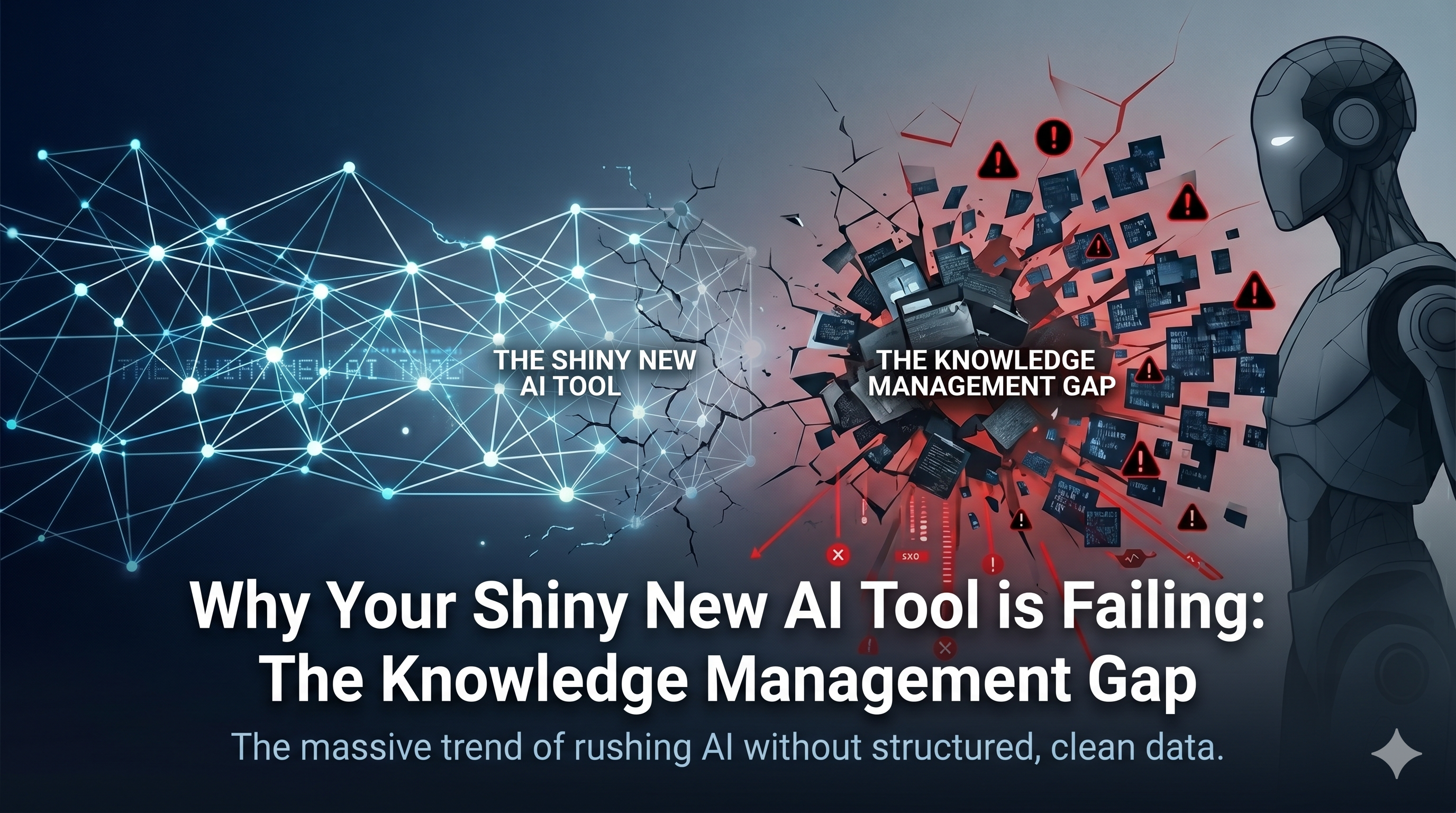
This article hits right at the core of a massive trend: companies rushing to implement flashy AI tools without ensuring they have the structured, clean data needed to feed them.
Before the AI Boom, Fix Your Knowledge Base
Artificial Intelligence has quickly become one of the biggest priorities for businesses. Every week, there seems to be a new AI-powered chatbot, search assistant, writing tool, or customer support solution promising to transform the way organizations work.
The message is hard to ignore:
- "Reduce support costs with AI."
- "Answer customer questions instantly."
- "Automate employee assistance."
- "Increase productivity with intelligent search."
With so much excitement surrounding AI, many businesses are rushing to adopt it. Management teams are approving AI projects, IT departments are evaluating vendors, and customer support teams are eager to introduce AI-powered assistants.
But amid all this enthusiasm, an important question is often overlooked:
Is your organization's knowledge ready for AI?
For many businesses, the answer is no.
Smart AI Needs Smarter Knowledge Management
One of the biggest misconceptions about AI is that it already "knows" everything about your business.
It doesn't.
AI models may have access to general information, but they don't know your company's products, internal processes, customer policies, or troubleshooting procedures unless you provide that information.
Consider a customer asking:
"How do I configure Single Sign-On for your application?"
If your organization has never documented the process, AI has no official source to reference. It may generate a generic answer based on common practices, but that answer could be incomplete, outdated, or simply wrong for your product.
Now imagine the same question when your knowledge base contains a detailed, reviewed article explaining every step of the configuration process.
Instead of guessing, AI retrieves the official documentation, summarizes it in plain language, and even links to the complete article for additional details.
The difference isn't the AI.
The difference is the quality of the knowledge available to it.
Businesses Are Investing in AI Before Investing in Knowledge
Many organizations spend months evaluating AI platforms, comparing language models, and planning chatbot deployments.
At the same time, they often overlook the state of their existing documentation.
It isn't uncommon to find organizations where:
- Support articles haven't been updated in years.
- Important procedures exist only in email conversations.
- Different departments maintain separate copies of the same documentation.
- Employees rely on experienced colleagues instead of documented processes.
- Customers receive different answers depending on which support representative they contact.
Adding AI to this environment doesn't solve these problems.
In fact, it often exposes them more quickly.
If the underlying information is inconsistent or outdated, AI simply delivers inconsistent or outdated answers faster.
AI Cannot Replace Good Documentation
Some organizations believe AI will reduce the need for documentation.
The opposite is true.
As AI becomes more capable, the importance of high-quality documentation actually increases.
Think of AI as an experienced librarian.
A librarian can quickly find the right book, summarize its contents, and point readers to the exact chapter they need.
But if the library is disorganized—or the books don't exist—the librarian cannot invent accurate information.
AI works the same way.
It excels at retrieving, organizing, summarizing, and presenting knowledge.
It does not replace the process of creating, reviewing, and maintaining that knowledge.
Poor Knowledge Management Creates Poor AI Experiences
Imagine deploying an AI assistant on your support portal.
During the first week, customers ask questions like:
- "How do I upgrade my license?"
- "Where can I download Version 10?"
- "How do I restore a backup?"
- "What are the API rate limits?"
If your documentation is incomplete, several things may happen:
- AI provides vague or generic responses.
- It references outdated procedures.
- It combines information from multiple versions of your product.
- It fails to answer altogether.
Customers quickly lose confidence.
Instead of reducing support tickets, the AI creates additional work because users now need to verify whether its answers are correct.
The issue isn't that AI failed.
The knowledge foundation failed.
A Knowledge Base Does More Than Store Articles
Many people think of a knowledge base as simply a collection of documents.
In reality, a well-managed knowledge base provides structure and governance for organizational knowledge.
It ensures that information is:
- Reviewed before publication.
- Updated whenever products change.
- Organized into logical categories.
- Easy to search and navigate.
- Accessible to the right audience.
- Maintained by clearly defined content owners.
This structure gives AI something reliable to work with.
Instead of searching through disconnected files, emails, and shared folders, AI retrieves answers from a trusted source of truth.
The Best AI Implementations Start with Better Knowledge Management
Organizations seeing the greatest success with AI usually have something in common.
They invested in knowledge management long before they invested in AI.
Their documentation is:
- Accurate.
- Current.
- Well organized.
- Consistently reviewed.
- Easy to discover.
As a result, AI becomes a productivity multiplier rather than a source of uncertainty.
It helps users find answers faster, summarizes lengthy documentation, recommends relevant articles, and improves self-service without compromising accuracy.
Before You Launch AI, Ask These Questions
Before deploying an AI assistant, take a moment to evaluate your knowledge base.
Ask yourself:
- Are our support articles regularly reviewed?
- Do we have duplicate or conflicting documentation?
- Can customers easily find the information they need?
- Is there a clear owner for every important document?
- Are outdated articles archived or removed?
- Do employees trust our documentation enough to rely on it?
If several of these questions raise concerns, improving your knowledge base should be part of your AI strategy—not an afterthought.
AI and Knowledge Management Are Partners, Not Competitors
There is a common misconception that AI will eventually replace traditional knowledge bases.
A more accurate view is that AI changes how people access knowledge, not where that knowledge comes from.
The knowledge base remains the authoritative source.
AI becomes the intelligent interface that helps users interact with that information more naturally.
Rather than choosing between AI and a knowledge base, successful organizations use both together.
Final Thoughts
The excitement surrounding AI is well deserved. It has the potential to improve customer support, employee productivity, and information discovery in remarkable ways.
However, AI is not a shortcut around knowledge management.
Without accurate, well-maintained documentation, even the most advanced AI assistant will struggle to provide reliable answers.
Before joining the AI rush, make sure your organization has invested in the one thing every successful AI implementation depends on: high-quality knowledge.
Because in the end, AI doesn't replace a knowledge base—it amplifies it.
How PHPKB Helps
A successful AI strategy begins with a reliable knowledge base. PHPKB helps organizations build that foundation by making it easy to create, organize, review, and maintain accurate documentation. With features such as a powerful WYSIWYG editor, structured categories, advanced search, version control, role-based permissions, and approval workflows, PHPKB ensures your knowledge stays current and trustworthy. Whether users search manually or interact with an AI assistant, the quality of the answers ultimately depends on the quality of the knowledge behind them—and that's exactly where PHPKB adds value.