From Spreadsheets to Systems: How Maintenance Teams Organize Scheduling Knowledge
Estimated Reading Time: 4 MinutesMaintenance teams often start with spreadsheets—and for good reason. Excel and Google Sheets are quick, flexible, and familiar. But as operations scale, what once worked smoothly starts creating friction.
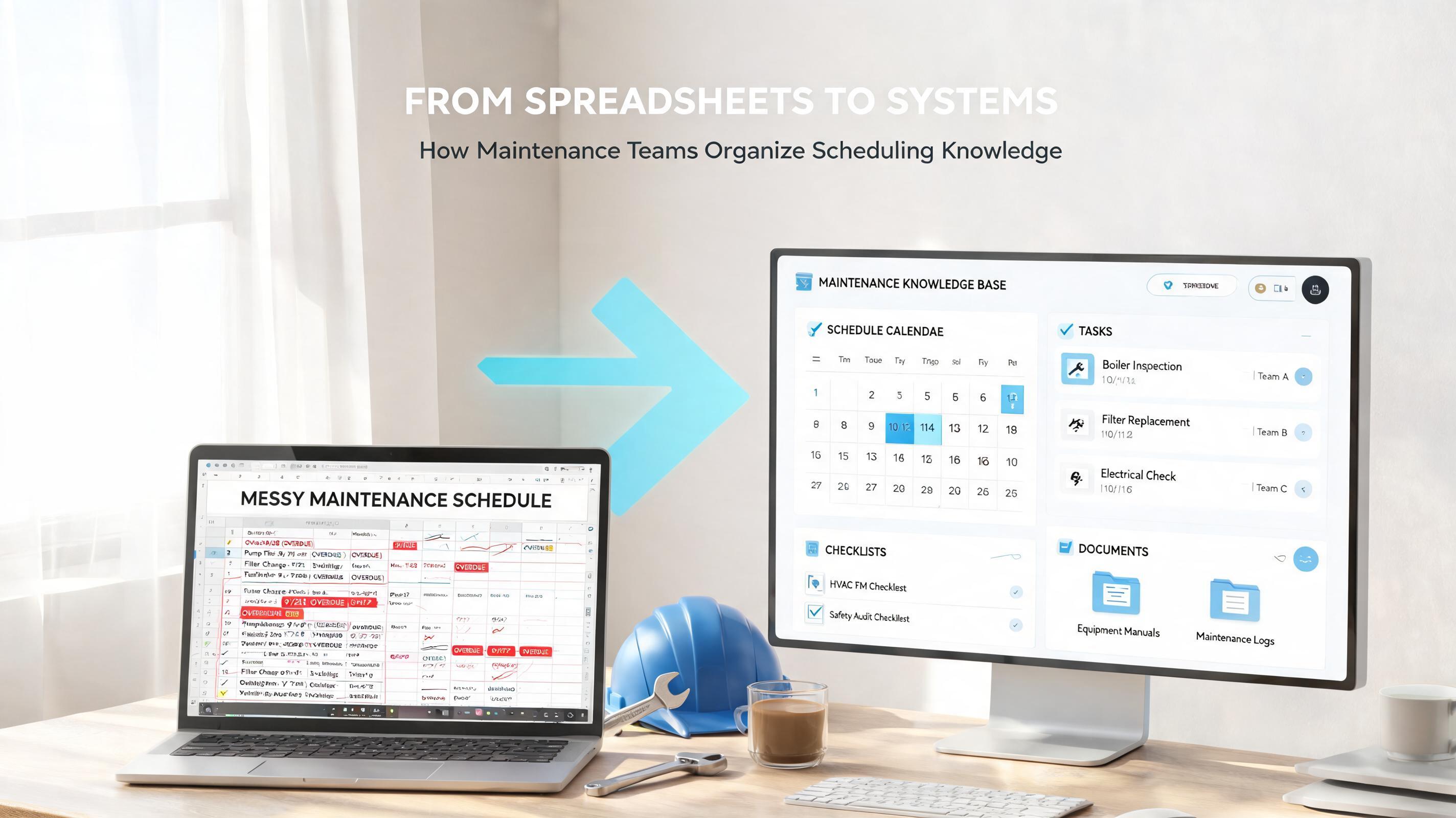
Missed schedules, inconsistent workflows, and knowledge silos begin to surface. At this stage, the problem is no longer scheduling—it is how scheduling knowledge is organized, shared, and maintained.
This is where a structured knowledge base system like PHPKB becomes essential.
The Hidden Cost of Spreadsheet-Based Scheduling
Spreadsheets are effective for tracking tasks, but they are not designed to manage operational knowledge.
As maintenance operations grow, teams face common challenges:
- Critical scheduling logic lives in formulas or personal understanding.
- Workflow dependencies are unclear or undocumented.
- Version control issues lead to conflicting updates.
- New team members struggle to understand “how things actually work.”
For example, a spreadsheet may show a preventive maintenance cycle, but it rarely explains why the interval exists, what exceptions apply, or how to handle delays.
This gap between data and understanding slows teams down and increases operational risk.
When Maintenance Teams Need More Than Excel
The shift away from spreadsheets typically happens when teams notice:
- Frequent scheduling conflicts or missed maintenance windows.
- Increasing reliance on senior staff for routine decisions.
- Longer onboarding cycles for new technicians.
- Difficulty standardizing processes across locations or teams.
At this point, adding more spreadsheets or tabs only adds complexity. What teams need is a centralized system that captures both schedules and the knowledge behind them.
Turning Scheduling Knowledge into Structured Documentation
Instead of relying on implicit knowledge, high-performing teams document their scheduling processes in a knowledge base.
With PHPKB, teams can create structured, searchable documentation that includes:
- Standard operating procedures (SOPs) for maintenance scheduling.
- Preventive vs corrective maintenance guidelines.
- Asset-specific scheduling rules and checklists.
- Escalation workflows and exception handling processes.
For instance, rather than just listing a “Next Service Date,” a PHPKB article can explain:
- How the date is calculated.
- What triggers rescheduling.
- Who approves changes.
- What steps to follow if a task is missed.
This transforms scattered knowledge into a single source of truth.
How PHPKB Improves Accessibility and Usability
A key advantage of using PHPKB is its ability to make operational knowledge easy to find and use in real time.
Maintenance teams benefit from:
- Advanced search capabilities that help technicians quickly locate relevant procedures.
- Categorized and structured content for different assets, teams, or locations.
- Role-based access to ensure the right information reaches the right users.
- Version control and revision history to track updates in scheduling policies.
For example, a technician in the field can search for “missed maintenance protocol” and instantly access a clear, step-by-step resolution guide.
Reducing Onboarding Time for Maintenance Teams
Onboarding is one of the most visible pain points in spreadsheet-driven environments.
Without proper documentation, new hires depend heavily on shadowing experienced staff. This slows productivity and creates bottlenecks.
With PHPKB:
- New technicians can follow documented workflows independently.
- Training becomes standardized and repeatable.
- Teams reduce reliance on tribal knowledge.
This leads to faster ramp-up times and more consistent execution across the team.
Preventing Institutional Knowledge Loss
When scheduling knowledge is not documented, it is vulnerable to employee turnover.
PHPKB helps organizations:
- Capture not just processes, but decision-making context.
- Maintain a living repository of operational knowledge.
- Continuously improve workflows through updates and revisions.
This ensures that knowledge stays within the organization, regardless of team changes.
Integrating PHPKB with Maintenance Systems
PHPKB complements existing tools such as CMMS platforms rather than replacing them.
A practical setup looks like this:
- CMMS manages work orders, schedules, and execution tracking.
- PHPKB provides the “how” and “why” behind each task.
For example, a CMMS task can link directly to a PHPKB article that explains:
- Detailed execution steps.
- Safety guidelines.
- Troubleshooting procedures.
- Escalation paths.
This integration bridges the gap between action and understanding.
A Practical Transition Strategy
Moving away from spreadsheets does not need to be disruptive. Teams can adopt a phased approach:
- Identify high-friction scheduling areas.
- Document those workflows in PHPKB.
- Encourage teams to reference the knowledge base during daily operations.
- Gradually reduce reliance on spreadsheets as the system matures.
Over time, PHPKB becomes the central hub for scheduling knowledge, while spreadsheets become secondary—or obsolete.
Why PHPKB Is a Strong Fit for Maintenance Teams
PHPKB is particularly well-suited for operations teams because it combines:
- Structured documentation with powerful search.
- Scalability for growing organizations.
- Easy content management for non-technical users.
- Secure, role-based knowledge sharing.
For maintenance teams transitioning from spreadsheets, it offers a clear path toward organized, accessible, and scalable knowledge management.
Final Thought
Spreadsheets organize data. PHPKB organizes knowledge.
For maintenance teams aiming to scale operations, reduce errors, and improve efficiency, that difference is transformative.